Asset Tracking 101: How to Stop Losing Equipment (and Money)

The Equipment Problem Nobody Talks About
Ask any operations manager at a field service company, construction firm, or multi-location business about their biggest headaches and equipment loss will come up — usually somewhere in the top three. Ask them how much it costs annually and you'll get a shrug.
That's the core of the problem. Most businesses don't know what they're losing because they have no system to track what they had in the first place.
A missing drill press, a generator that's been "borrowed" between job sites for six months, a fleet of tablets that nobody can account for — individually, each one is a nuisance. Collectively, they represent a meaningful percentage of your operating costs, and unlike payroll or rent, they're almost entirely preventable.
What Asset Tracking Actually Means
Asset tracking is the practice of maintaining a real-time or near-real-time record of where your physical assets are, who has them, and what condition they're in.
For some businesses, that means GPS hardware attached to vehicles and heavy equipment. For others, it means a barcode or QR code system where employees scan items when they check them in or out. For others still, it means RFID tags that update automatically when equipment passes through a doorway.
The right approach depends on what you're tracking and how it moves. A fleet of company vehicles needs GPS. A toolroom full of power tools probably just needs a check-in/check-out log with barcodes. A server room needs something in between.
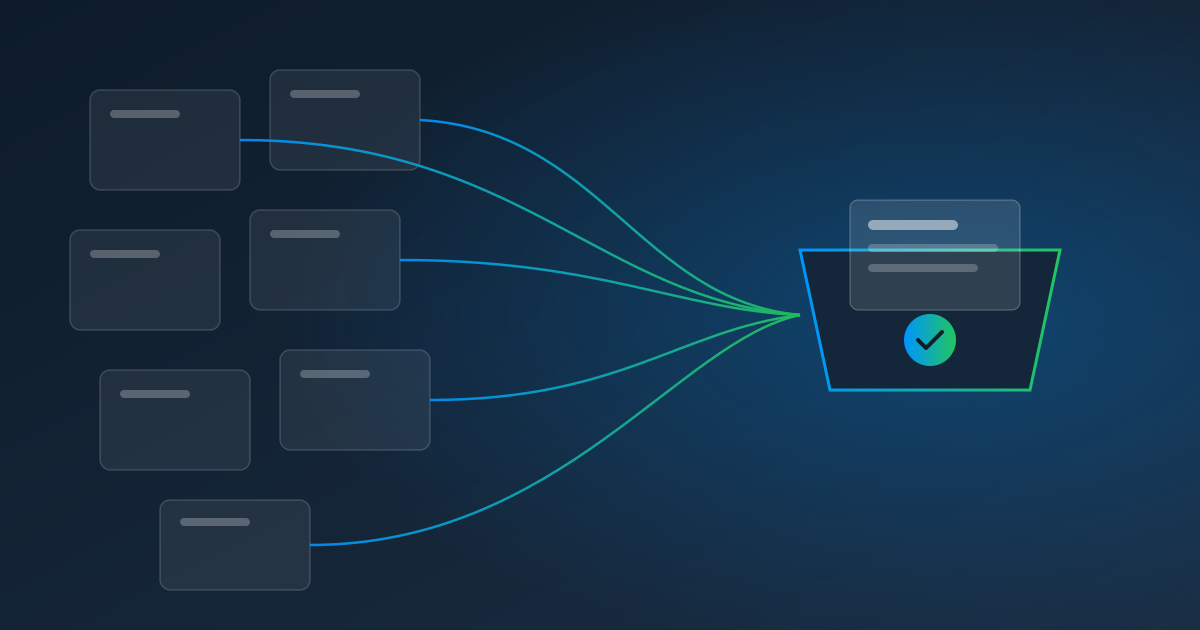
What all of these share is a database: a central record of every asset, its current status, its location, and its history.
The Real Cost of Not Tracking
Most businesses underestimate their asset losses because they account for them in the wrong category. Equipment that disappears doesn't show up as a line item called "stolen drill." It shows up as:
- Unexpected capital expenditure when you buy a replacement for something that still exists somewhere
- Project delays when a job site calls for equipment that can't be located
- Write-offs at year-end that your accountant treats as routine depreciation
- Insurance premiums that reflect a higher-than-necessary loss history
A rough industry estimate is that businesses lose 1–3% of their equipment value annually to loss, theft, and untracked damage. For a company with $500,000 in tools and equipment, that's $5,000–$15,000 per year — enough to fund a part-time employee or significantly offset software costs.
The Four Biggest Asset Management Mistakes
1. No Central Inventory
If your asset list lives in someone's head, a spreadsheet that's three months out of date, or across a dozen filing cabinets, you don't have an asset list. You have a collection of guesses.
A real inventory starts with a physical audit — walking the facility, counting everything, and logging it in a system. This is painful to do once and essentially free to maintain afterward, which is why most businesses put it off indefinitely.
2. No Check-In / Check-Out Process
When equipment is shared across employees or job sites, it needs a chain of custody. Someone needs to be accountable for each item at any given time. Without a formal check-out process, accountability defaults to "whoever touched it last" — which is effectively no accountability at all.
A check-out process doesn't have to be complicated. A barcode scan and an employee ID is enough to establish who has what. The key is that the system records it automatically, not that someone fills in a paper form.
3. No Condition Logging
An asset that returns from a job site damaged and gets quietly shelved without documentation is an asset you'll eventually buy twice. Condition logging — even just a simple photo at check-in and check-out — creates a record that makes accountability possible and insurance claims easier.
4. No Maintenance Scheduling
Equipment that isn't maintained breaks earlier than it should. A generator that should be serviced every 250 hours but gets serviced when someone remembers will cost more to repair and have a shorter lifespan. Asset tracking systems that include maintenance scheduling prevent this — the system tells you when service is due, not the equipment telling you via a breakdown.
How to Build a Basic Asset Tracking System
You don't need to solve everything at once. A practical implementation path:
Week 1 — Physical audit: Walk every location, log every asset worth more than a threshold you set (e.g., anything over $100). Photograph each item. Record make, model, serial number, and purchase date if you have it.
Week 2 — Label everything: Apply barcodes, QR codes, or asset tags to each item. This is the unglamorous part, but it's the foundation everything else builds on.
Week 3 — Establish check-out procedures: For portable equipment, set a simple rule: scan before you take it, scan when you return it. The first week won't be perfect. Keep enforcing it.
Month 2+ — Add maintenance schedules and reporting: Once you have a clean inventory and an active check-out log, layer in maintenance reminders and run monthly reports on utilization, losses, and items that have been checked out unusually long.
What Pulse Asset Tracking Offers
Pulse Asset Tracking handles the database, the check-in/check-out workflow, and the reporting — so you don't have to build it yourself.
Every asset gets a record. Employees check items in and out through the Pulse app. You can see at a glance what's where, who has it, and how long it's been out. Maintenance schedules send reminders before equipment is due for service, not after it breaks.
Because Pulse is priced per transaction rather than per seat, the cost scales with your usage — you're not paying for a platform that's mostly idle. For most small and mid-sized operations, the monthly cost is recovered within the first month or two of loss prevention alone.
A Word on Employee Buy-In
Asset tracking works best when employees understand why it exists. The conversation to have is straightforward: when equipment goes missing, everyone pays — through reduced budgets, delayed projects, and sometimes layoffs. A check-out system isn't about distrust; it's about making sure the tools are there when they're needed.
Most employees, especially those who have been on a job site where equipment couldn't be found, will understand immediately. The ones who push back hardest are often the ones who've been quietly "borrowing" equipment. That reaction itself is informative.
Getting Started
The hardest part of asset tracking is the initial audit. Once that's done, the ongoing maintenance is minimal. Start with your highest-value or highest-risk equipment — whatever gets lost most often or costs the most to replace — and build from there.
Start a free 30-day trial of Pulse and run your first asset audit inside the platform. You may find equipment you forgot you had. You may also find gaps that explain some of those mystery write-offs.
See the full feature details on the Asset Tracking page, or explore how Pulse combines asset tracking with Time Tracking and Workforce Insights in a single platform.